The ceremony dates back to the time of the Buddha when Maudgalyayana, a great disciple of his, meditated and much to his misery, found that his mother had been reborn in the realms of pain and suffering.
Since his mother’s spirit was suffering from hunger, he decided to go to the nether world to offer food to her. Unfortunately, when his mother tried to eat the food, it turned into burning charcoal. Being so sad, he consulted the Buddha.
The Buddha told him that his mother's bad karma was deep-rooted, and that he should hold an offering ceremony to the Shanga and pray with them for liberation of his mother's soul. The Buddha also said by doing so, the disciple saved not only his mother but also his forefathers, who would escape sufferings and attain eternal bliss and salvation in the end.

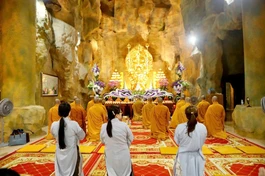
Following the Buddha’s teachings, many Vietnamese lay-people go to pagodas on that day to make offerings to the Buddha and Shanga to pray for the longevity and happiness of their parents and for the liberation of their departed parents and relatives.
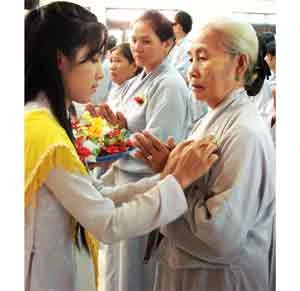
Everybody, whether a Buddhist follower or not, who comes to a pagoda that day will be pinned a red rose on his pocket or lapel if his or her mother is alive, or a white rose if the mother has passed away.
The pinned rose serves to remind them of their parents’ sacrifice and devotion, especially by the mothers. And those who wear a red flower show their sympathy to those who get a white rose.
To the Vietnamese people, their parents are wonders of the world. So if you wish to express your gratitude and filial love to your parents, whether they are still alive or not, in the Vu Lan festival, drop by a pagoda to receive a rose.
This year, the 15th day of the seventh lunar month falls on Friday, August 15, 2008.
_1.jpg.webp)
_1.jpg.webp)
![[TRỰC TUYẾN] Hòa thượng Thích Lệ Trang thuyết giảng: "Thực hành diệt trừ phiền giận"](https://image.giacngo.vn/280x186/Uploaded/2026/estnselxslt/2026_10_24/img-7673-5277-5059.jpeg.webp)
![[TRỰC TUYẾN] Hòa thượng Thích Lệ Trang thuyết giảng: "Ân đức cha mẹ"](https://image.giacngo.vn/80x80/Uploaded/2026/estnselxslt/2026_10_17/img-7561-8563-6183.jpeg.webp)

![[Video] Đồng loạt công bố quyết định chuẩn y các Ban chuyên môn, Văn phòng Ban Trị sự GHPGVN TP.HCM](https://image.giacngo.vn/80x80/Uploaded/2026/estnselxslt/2026_10_10/img-7414-4852-7941.jpeg.webp)
![[TRỰC TUYẾN] Đại lão Hòa thượng Thích Trí Quảng thuyết giảng: "Hồng danh Pháp hoa"](https://image.giacngo.vn/80x80/Uploaded/2026/estnselxslt/2026_10_03/img-7316-4208-2483.jpeg.webp)
![[TRỰC TUYẾN] Hòa thượng Thích Lệ Trang thuyết giảng: "Ý nghĩa Thuyết U minh giới trong Đại giới đàn"](https://image.giacngo.vn/80x80/Uploaded/2026/xpcwvolc/2026_09_25/1790334771152-1775654101107392097-1775654101107392097-d80e1fc07e494f3927eb9dfd8f1c2eae-4260-3687.jpg.webp)